
The world makes TV.
Who connects us?
A British documentary. A Filipino drama. News in your own language, far from home. Behind the screen is an international network of agreements—and an opportunity to reach viewers who have not yet found the right offer.
By Orgs United · Updated
It starts on the sofa
You live in another country. You have internet, a good screen and a wish that should be simple: to watch something familiar. News from home. Humour you understand without subtitles. A series your family is talking about.
Then the search begins. Which app? Which subscription? Does it work where you live? And why is a programme available in one place but missing in another?
Here is an intriguing question for the entire TV industry: Who can connect the right content with the people who want to watch it?
A new TV service does not have to start with a film studio
It is easy to assume that a large selection requires a provider to make everything itself. But content can also be acquired through agreements with those who produce, own or are authorized to distribute it.
BBC Studios describes how its productions are sold to international broadcast and streaming partners. The same story can find an audience far from the country where it was made. [1]
For a new service, the challenge may therefore be finding the right partnerships, securing the necessary rights and assembling an offer that reaches an audience. That takes money, negotiation and delivery—but not necessarily cameras and actors of its own.
Three ways content can reach the screen
1. Viewing rights: content finds a new home
A service can agree to show particular films, series or channels. The agreement defines what is covered and how it may be used. Viewers see the content; the negotiations happen behind the scenes.
2. Distribution: one connection can open several doors
A distributor may represent a content catalogue and license rights to broadcasters and streaming services. That can allow several productions to be negotiated through one contact. What the distributor can offer depends on its mandate and actual rights.
3. Aggregation: several offers share one entrance
An aggregator brings together content, channels or services, but its role varies. Some integrate playback, while others organize subscriptions or help viewers find what to watch.
Prime Video, for example, offers access to other streaming services through additional subscriptions in markets where they are offered. Customers can find and manage several subscriptions in one place. This does not mean everything is included in the base price. [2]
JustWatch illustrates another role: helping viewers find which service offers a film or series. A discovery guide is not the same as a rights holder or the supplier of everything it lists. Explore JustWatch ↗
Imagine this
A family lives in the Philippines. One person wants news from Norway. The other wants Filipino entertainment. Both enjoy international films.
A service hoping to reach this family could explore partnerships with several content suppliers. One might offer regional channels, another a film catalogue, and a third something in the family’s language.
The value lies in making the pieces work together for the customer. Relevant content, easy navigation, clear prices and help when something stops working.
This is a hypothetical need and possible model. It does not describe an available subscription or confirmed agreements with any specific provider.
Can two providers show each other’s content?
This can be a possible partnership model if both have authority to grant the necessary permission. But collaboration need not be an exchange. It might involve buying rights, redistribution, a revenue-sharing arrangement or several services brought together on one platform.
This is what makes the field interesting: two businesses may each have something the other needs. One may have content; the other may have technology, local connections or access to an audience. Whether it becomes a good offer depends on the agreements, costs and what viewers actually want to pay for.
The internet is global. TV agreements have boundaries.
A stream can technically travel a long way. That does not mean permission to show it applies everywhere. The content, countries, agreement period and distribution method must match the offer.
An agreement for one series does not automatically cover the whole channel. A programme library does not necessarily include live sport. And taking a subscription on holiday is different from having a right to purchase it as a resident of another country.
EU guidance on online content abroad distinguishes temporary stays from access to other countries’ offers. [3] So the practical question is always: What can I actually watch where I am?
Perhaps the most interesting audience lives between countries
Someone may live in Spain, have family in Norway and follow an international sport. Someone else works in Thailand and wants news in their first language. A family may use several languages around the same dinner table.
That suggests an opportunity worth investigating: TV offers shaped by people’s languages and interests, as well as the country they live in.
For Orgs United, it is natural to explore this connection. Organizations, portals and online groups may know an audience well. A TV provider may have a relevant offer. If rights and terms are in place, partnerships and affiliate agreements may be a way to introduce it. Participation is voluntary, and any commission follows agreed sales terms.
Explore the connections on a world map
Where do people from different countries live? Explore the population figures and how they can help us understand communities across borders.
304 million people: map and explanation →What do we look for when assessing TV providers?
Orgs United explores potential providers. A specific offer will only be presented once the necessary rights, availability and written terms have been documented. We want to explain what confirmed information means for viewers.
- New partnerships: Who are the parties, and what does each contribute?
- Content: Which channels, films, series or sports events are covered?
- Availability: Which countries, languages and customer groups does the offer cover?
- Use: Which devices are supported, and how easy is it to get started?
- Price: What is included, what costs extra, and which terms apply?
A press release can be the start of an interesting story. We also want to see what customers can actually access, distinguishing announced plans from available services.
The story lies in the connections
The world’s TV content already exists across countless productions, channels and catalogues. The exciting part is what happens when someone finds a new route from content to audience.
A documentary finds new viewers. A local story crosses an ocean. A family far from home finds something to enjoy together.
This is the development we want to explore: who collaborates, which doors open—and what ends up on your screen.
Sources and further reading
- BBC Studios: production and international distribution ↗
- Amazon: how additional Prime Video subscriptions work ↗
- Your Europe: online content during temporary stays and relocation ↗
BBC Studios and Prime Video describe their own models. These examples do not document a connection to Orgs United or a potential provider. Hypothetical opportunities and Orgs United’s views are identified in the text.
From knowledge to collaboration
Orgs United explores how clubs, organizations and representatives can earn commission from voluntary purchases of useful services. Specific offers depend on the provider’s documented rights and written terms.
ORGS UNITED · FOUR PANELS FROM TV LIFE
Two home countries. One remote.
A little story about big connections—and the final negotiation on the sofa.
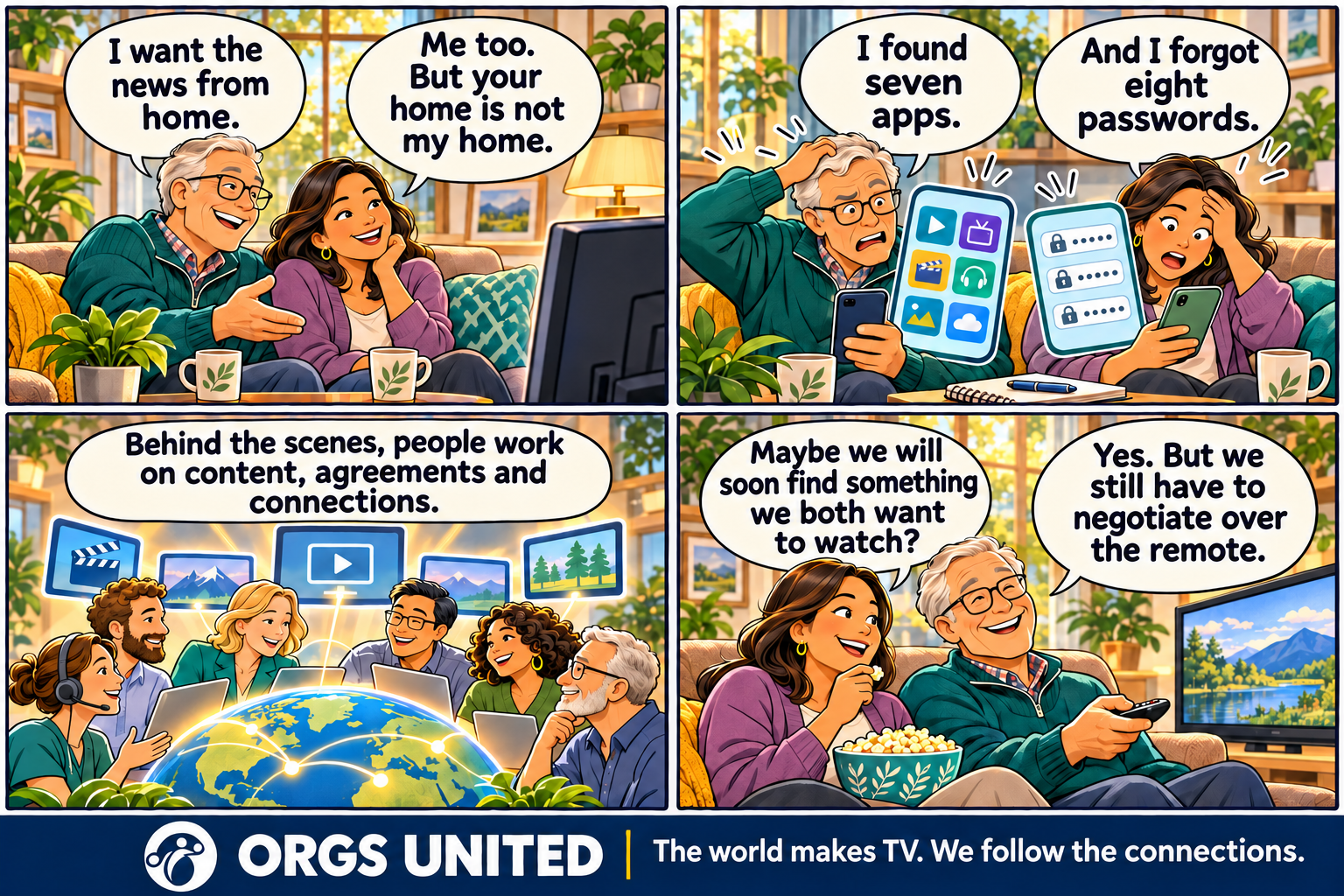
- He: “I want the news from home.” She: “Me too. But your home is not my home.”
- He: “I found seven apps.” She: “And I forgot eight passwords.”
- Behind the scenes, people work on content, agreements and connections.
- She: “Maybe we will soon find something we both want to watch?” He: “Yes. But we still have to negotiate over the remote.”
The world makes TV. We follow the connections.