The customer chooses a service
The service needs to offer value to its user. Members and other customers decide for themselves whether to subscribe.

A provider offers a service. Someone recommends it. When that recommendation leads to a qualifying purchase, the provider may pay commission.
The service needs to offer value to its user. Members and other customers decide for themselves whether to subscribe.
A personal link or code connects the purchase to its referrer. Provider rules determine how a sale is attributed.
Commission follows provider terms. Some programmes offer a one-off payment; others pay recurring commission on active subscriptions.
Based on the current plan, one person in the association can normally complete the initial setup in a couple of hours. The association registers through the affiliate link it receives, then shares its own member link with its members, who register their subscriptions themselves. The association also decides whether to invite other associations to the same opportunity, perhaps five to fifteen, using a ready-made message available on Orgs United. This is essentially the whole task based on what we know today. If anything changes, we will update the information.
The customer pays the provider for the service. The provider allocates part of its revenue to qualifying referral commissions. The organisation does not have to deliver the service itself. Payment, support and responsibilities must be checked for each offer.
Recommends the service to its own customers and introduces organisation B.
Develops its own activity and introduces organisation C.
Recommends the service to its own customers.
If the provider’s system permits it, A may earn commission from qualifying sales through B and C as well as its own sales. Each level may have different rates and requirements. Invitations alone generate no income in this example.
Each group keeps its name, leadership and member relationships. It decides whether to participate and whom to introduce. Affiliate placement and commission follow the provider’s rules; this is separate from the organisation’s own structure.
Everyone heads the network they personally build — whether they are a representative, group, club or organisation. In this unilevel example, each participant places all their personally introduced contacts alongside one another in their own first line. Each new participant does the same with their own contacts. Each builds their own network as part of the wider community.
Build your first line as broadly as possible and give everyone you introduce the same explanation: place your own contacts in your own first line, and teach them to do the same. This can develop breadth across many independent branches. Everyone has the opportunity; not everyone will choose to build actively. Commission follows qualifying sales and provider terms, not breadth alone.
Example: You directly introduce A, B and C. All three are in your first line. When A introduces D and E, D and E are in A’s first line and your next network level. A, B and C each develop their own independent activity.
ORGS UNITED · THE CLUB WITH 18 MEMBERS
An illustrated possibility, not a forecast or earnings promise.
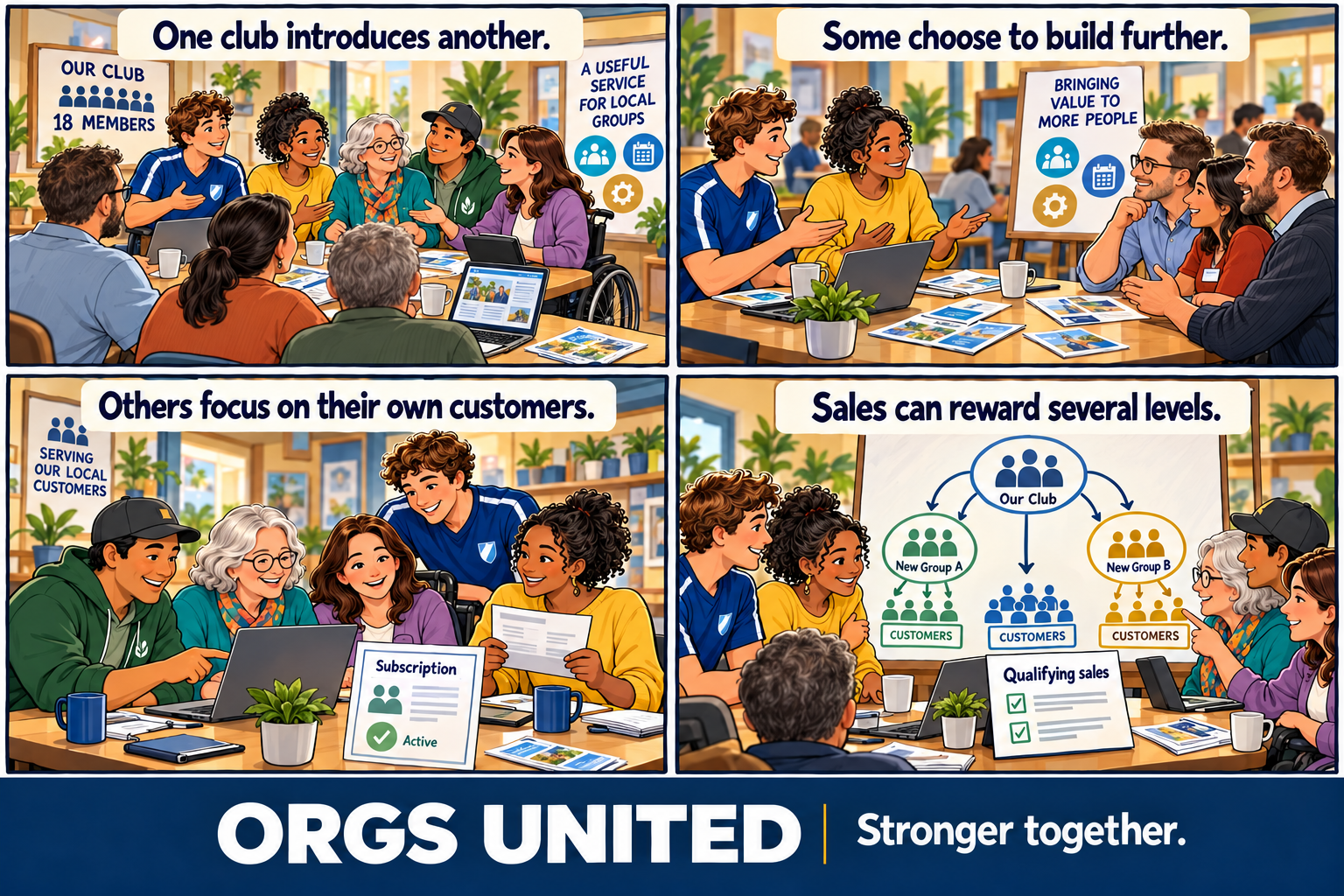
This is a unilevel example, not one method for every provider. If a company uses a different affiliate system, we must adapt the organisation, explanation and calculation model. As soon as we know the system and its written terms, we update how participants register, how the network is built and how commission is calculated.
Try the calculator. Change the breadth of your first line, the share who build further and the number each active participant introduces. See how participants, customers and potential gross commission change with your assumptions.
Explore breadth in the calculator ↗Find a natural first contact among associations, housing communities, workplace sports clubs, Facebook groups, web portals and communities across countries.
Explore potential audiences ↗An initial conversation carries no commitment.
A small club may have few members, but strong connections and the drive to help others get started. By introducing other organisations, you can build a network that reaches many more customers than you reach alone.
Affiliate marketing has long been available to small participants too. Large websites benefit from high visitor numbers. In a multilevel system, qualifying sales within the network you build may also generate commission. Initiative, follow-up and helping others can therefore have real value.
In a model without a personal subscription requirement, an organisation may earn commission from qualifying network purchases without buying a subscription itself. Whether a specific offer allows this must be confirmed in its terms. Real purchases generate the commission basis; invitations alone do not.
Explore the potential in the calculator ↗